Subscribe to Feed

Subscribe to our RSS Feed of latest updates.

Frequently Asked Questions

The community planning process for the future use of Naval Air Station-Alameda began shortly after the announcement in 1993 that the Navy base would be closing. Thirteen years after the official closing in 1997, the planning process reached a pivotal moment on February 2, 2010, when voters defeated a ballot measure by land developer SunCal for redevelopment of Alameda Point (Measure BSunCal's ballot measure to redevelop Alameda Point. It was defeated by a vote of 85 to 15 percent on February 2, 2010. ). Below are new questions facing Alameda.

New Questions (14)

The projected date for completion of cleanup by the Navy is 2017.

SunCal submitted a Measure A(1973) The actual text of what is known as Measure A is article 26 of the Alameda City Charter. It reads as follows: "Sec. 26-1. There shall be no multiple dwelling units built in the City of Alameda. Sec. 26-2. Exception being the Alameda Housing Authority replacement of existing low cost housing units and the proposed Senior Citizens low cost housing complex, pursuant to Article XXV of the Charter of the City of Alameda. Sec. 26-3. The maximum density for any residential development within the City of Alameda shall be one housing unit per 2,000 square feet of land. This limitation shall not apply to the repair or replacement of existing residential units, whether single-family or multiple-unit, which are damaged or destroyed by fire or other disaster; provided that the total number of residential units on any lot may not be increased. This limitation also shall not apply to replacement units under Section 26-2." -compliant plan on March 22, 2010. The city council voted on July 20, 2010, to deny SunCal’s development proposal for Alameda Point and their three-year exclusive negotiating agreement expired.

A Density Bonus Ordinance was adopted by the city council on December 1, 2009.
The ordinance allows developers to exceed current zoning density limitations by five to 35 percent in exchange for constructing affordable housing, senior housing and child care facilities.

The Density Bonus Ordinance brings Alameda in line with current state code regarding this form of developer incentive. We don’t know how many units would be possible at Alameda Point using the density bonus ordinance because we do not know what land plan this would be applied to at this time.

The Superfund cleanup process by the Navy will be officially complete in about seven years. In prior discussions with the Navy, the city declined the option for early transfer, fearing it would get stuck with the cost overruns for the cleanup.

In prior discussions with the Navy, the Navy rejected the idea of a piecemeal conveyance as parcels are certified clean. It remains to be seen whether federal or local policies will change.

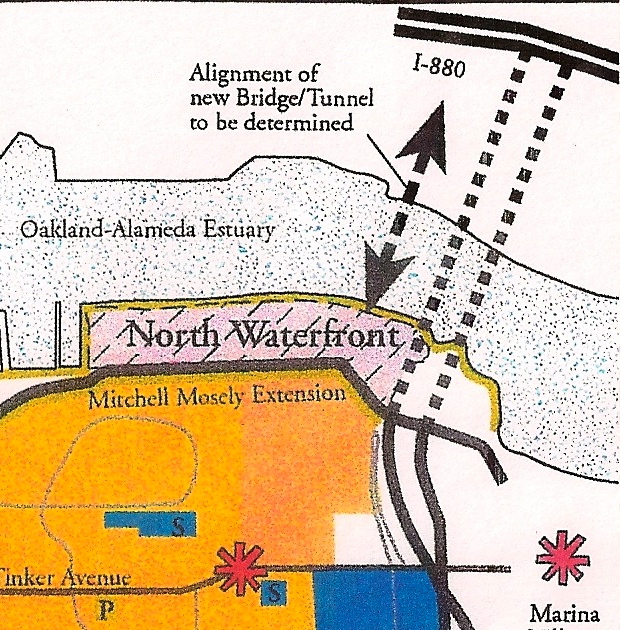
A new bridge is not feasible due to the height required by the Port of Oakland. A drawbridge is unlikely, as it would interfere with the rapid response requirement of the Coast Guard ships located at Coast Guard Island.

We are not aware of any feasibility studies ever performed on the construction of an additional tunnel to Oakland. However, the 1998 “Draft Report – Alameda Point Financing Plan" assumes that no new bridge or tunnel will be built due to the report's educated guess that either crossing would cost between $300 and $700 million (in 1998 dollars).
Operation of ferries requires regular dredging at the entrance to the Seaplane Lagoon. Dredging will disturb toxic sludge, therefore it must be cleaned up first.

The Superfund cleanup process the Navy is doing will not take care of the toxic sludge. The Navy is only removing solid objects from two corners of the Seaplane Lagoon.

The party responsible for the cleanup of toxic materials has not been determined. Options are: a) The Navy, via price and terms negotiations with the city for the transfer of the land; b) master developer; c) regional water transit agency (WETAWater Emergency Transportation Authority ) whose mission includes facilitating ferry terminal improvements on the bay.

Yes, barring any unforeseen problems. At its November 2009 meeting, the WETAWater Emergency Transportation Authority Board unanimously approved a $200,000 design and engineering contract for the facility. The contract currently being negotiated between the city and WETA is for a 65-year lease.

Lease revenue from the facility would be $58,000 per year and go to the city’s general fund, and not the ARRAAlameda Reuse and Redevelopment Authority. The City Council acts in this capacity. fund.

The facility would be located on the dock area just east of the USS Hornet, next to where the park district anticipates operating a boating facility at Enterprise Park.

The Alameda Point PDCPreliminary Design Concept is a planning study for the redevelopment of Alameda Point. It was completed in 2006 and was intended to serve as the framework for an Alameda Point Master Plan. It builds on the policy goals adopted in the 1996 Community Reuse Plan for Alameda Point, which were incorporated into the city’s General Plan in 2003 along with a set of objectives. These objectives are:

• Seamlessly integrate Alameda Point with the rest of the city
• Foster a vibrant new neighborhood
• Maximize waterfront accessibility
• De-emphasize the automobile and make new development compatible with transportation capacity
• Ensure economic development
• Create a mixed-use environment
• Establish neighborhood centers

The PDC incorporates input from a series of community workshops held between August 2004 and June 2005. The PDC complies with Measure A(1973) The actual text of what is known as Measure A is article 26 of the Alameda City Charter. It reads as follows: "Sec. 26-1. There shall be no multiple dwelling units built in the City of Alameda. Sec. 26-2. Exception being the Alameda Housing Authority replacement of existing low cost housing units and the proposed Senior Citizens low cost housing complex, pursuant to Article XXV of the Charter of the City of Alameda. Sec. 26-3. The maximum density for any residential development within the City of Alameda shall be one housing unit per 2,000 square feet of land. This limitation shall not apply to the repair or replacement of existing residential units, whether single-family or multiple-unit, which are damaged or destroyed by fire or other disaster; provided that the total number of residential units on any lot may not be increased. This limitation also shall not apply to replacement units under Section 26-2." and calls for approximately 1,800 new residential units.

Aircraft Carrier Hornet Foundation
Alameda National Wildlife Refuge
Alameda Naval Air Museum (ANAM)
Alameda Point Storage, Inc.
Alameda Municipal Power
Alameda Point Collaborative
Auctions by the Bay / Antiques by the Bay
American Bus Repair / MV Transportation DBA: Coach Specialties
Alameda Soccer Club
Architectural Glass & Aluminum
AT&T
Bay Ship & Yacht Co.
Bladium, Inc.
Building 43 & Associates (aka: West Coast Seaworks)
City of Alameda
Cameron-Cole
Chabot Space & Science Center
Event Productions
Community Bible
Conmar, Inc.
Container Storage, Inc. (aka CSI Ministorage)
Delphi Productions
Dreyfuss Capital Partners
General Services Administration
GFC Moving and Storage
GRM (Simmba)
Habitat for Humanity East Bay
Jetsmart / Alameda Aerospace
HESCO
JK Communications & Construction
Jim Bustos Plumbing
Nelson's Marine
Makani Power, Inc.
Maritime Administration
Navigator Systems, Inc.
The Pacific Pinball Museum
TowerCo Assests LLCLimited Liability Corporation (formerly Sprint/Nextel)
NRC Environmental Services Including Port Services
Pacific Fine Food, Inc.
Piedmont Youth Soccer Club
Sacchi Enterprises
Shaw Environmental
DBA: Trident Port Services [NRC]
Power Engineering
Puglia Engineering
Rockwall Wine Company, Inc.
San Francisco Tom's Sales
St. George Spirits, Inc.
Stafford Stafford Sent Packing
Sustainable Technologies
Trans Freight Express
Turnkey Productions
Vigor Marine
Waterfront Development Group
West Coast Novelties
Woodmasters

Time requirements do not allow SunCal to place another Measure A(1973) The actual text of what is known as Measure A is article 26 of the Alameda City Charter. It reads as follows: "Sec. 26-1. There shall be no multiple dwelling units built in the City of Alameda. Sec. 26-2. Exception being the Alameda Housing Authority replacement of existing low cost housing units and the proposed Senior Citizens low cost housing complex, pursuant to Article XXV of the Charter of the City of Alameda. Sec. 26-3. The maximum density for any residential development within the City of Alameda shall be one housing unit per 2,000 square feet of land. This limitation shall not apply to the repair or replacement of existing residential units, whether single-family or multiple-unit, which are damaged or destroyed by fire or other disaster; provided that the total number of residential units on any lot may not be increased. This limitation also shall not apply to replacement units under Section 26-2." -amending initiative on the ballot before the ENAExclusive Negotiating Agreement expires. It is unknown whether the city or any other entity will place one on the ballot in the future.

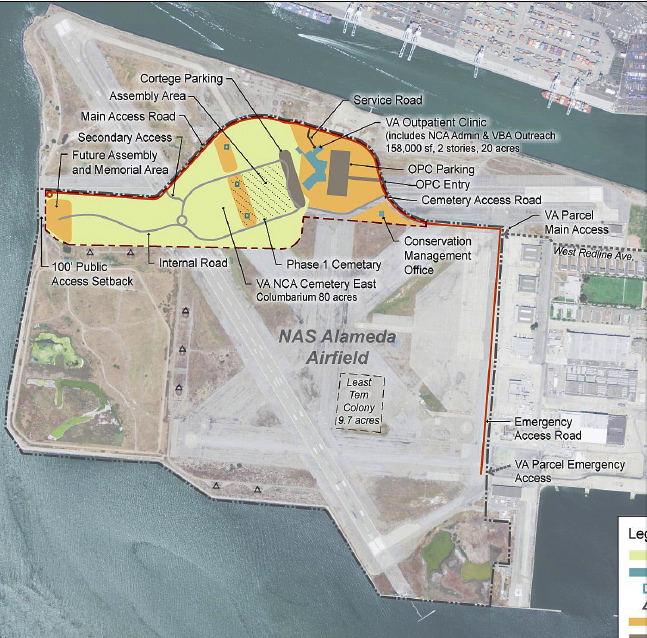
In an effort to consolidate and improve its Northern California service to veterans, the Veterans Administration has proposed a new state-of-the-art treatment facility and offices at Alameda Point. The facility is to be built on part of the land currently designated as Wildlife Refuge. A columbarium is also proposed as part of this project.

The VA’s budget request to Congress for the year 2011 includes $17 million for design work on the proposed facilities at Alameda Point. Total estimated cost to complete the project is $210 million.

1) Single master developer (master plan) or multiple developers chosen by city.

2) Community Development Corporation—city acts as its own master developer and seeks funding from government, private and nonprofit sources.

3) Public or Community Land Trust—government- or privately controlled trust. Trusts are usually set up with a preservation goal in mind (historic, natural, or to preserve neighborhood character or housing affordability).

4) Joint Powers Authority—city partners with State of California to form a new reuse authority. Such authority would make joint decisions, and benefit from clout of the state.

5) Auction by the Navy—land is acquired by the highest bidder, who then must comply with the usual city zoning laws and processes.

In 2004, the Oakland Chinatown sued the City of Alameda in anticipation of development at Alameda Point and its traffic impacts on Chinatown. The lawsuit ended with an out-of-court settlement on April 19, 2004. The settlement requires cooperation between the parties on future planning and adds an additional requirement to the EIREnvironmental Impact Report process: a review of traffic impacts on the neighboring community of Chinatown. Normally, EIRsEnvironmental Impact Reports do not require evaluation of impacts on neighboring cities.

A joint committee established by the settlement (the Oakland Chinatown Advisory Committee) meets periodically to advise both the Oakland City Council and the Alameda City Council about traffic impacts of development at Alameda Point.

During the Measure BSunCal's ballot measure to redevelop Alameda Point. It was defeated by a vote of 85 to 15 percent on February 2, 2010. campaign, Chinatown challenged the City of Alameda for placing a development initiative on the ballot without an EIR, which the settlement agreement calls for. Since Measure B failed, this challenge is now moot. The settlement agreement, however, is still in force.

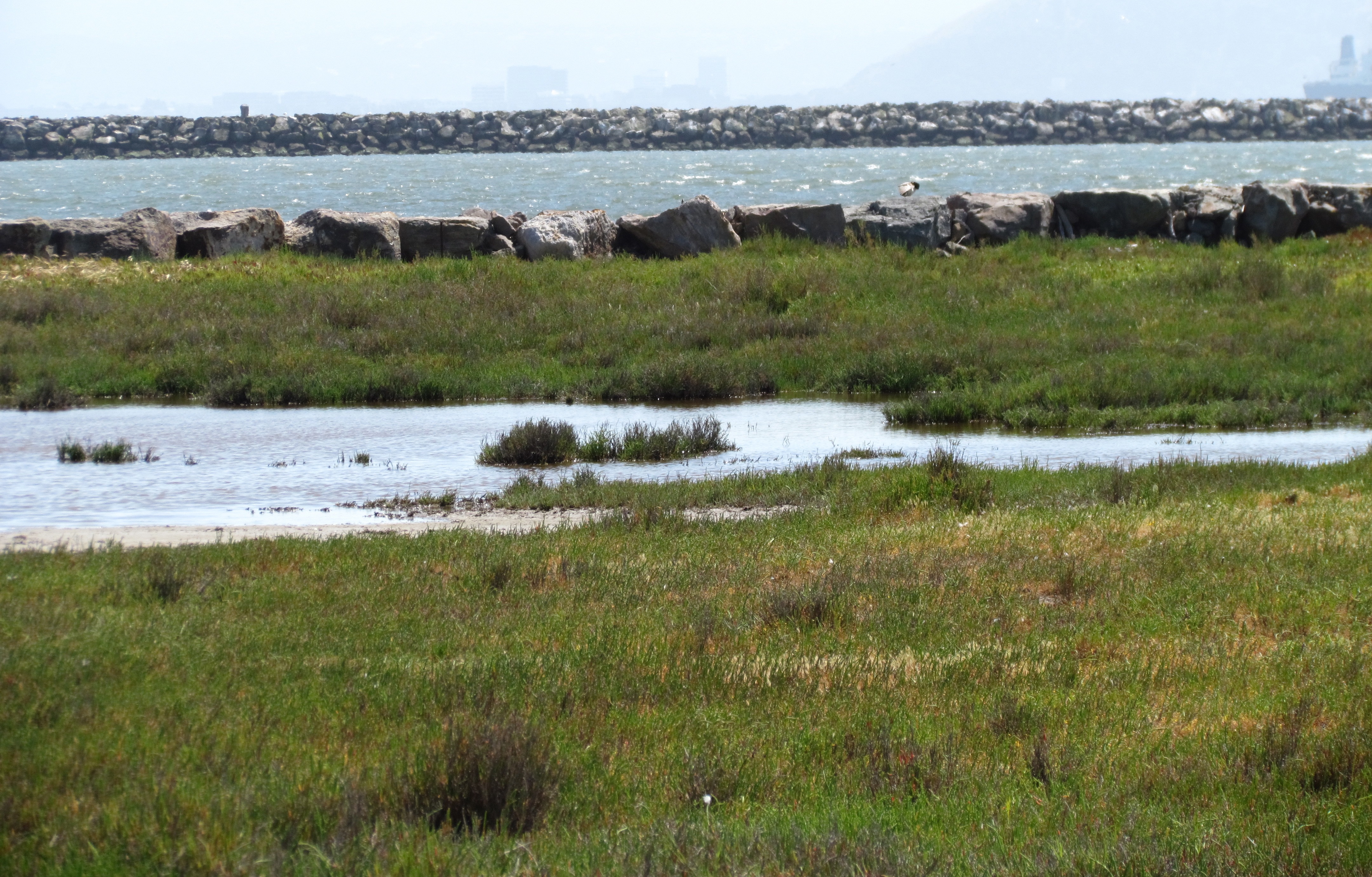
Yes. Two wetland delineation reports in 2004 identified 18.6 acres of wetlands. Much of the Northwest Territories is only a few feet above sea level.

Filling and grading a vast swath of low-lying land for commercial use would be very expensive and probably not cost effective for business use. Turning the low-lying areas into natural habitat, on the other hand, would be a much simpler engineering feat. The ability of wetlands to capture global warming CO2 also adds merit to the natural habitat alternative.

Once conveyed to the city, the Northwest Territories will be zoned as public trust land, as required under state law. Natural resource preservation is a permitted use under public trust land zoning. Various programs exist for assisting in wetlands preservation and expansion.

Measure-B-Archive (16)

On February 2, 2010, Alameda voters were asked to vote Yes or No on a ballot measure written by SunCal Corporation for redevelopment at Alameda Point, formerly known as Naval Air Station–Alameda. The initiative was a complex set of documents almost 300 pages long. Below are the major questions raised during the campaign.

Yes, it matters whether you vote.

A YES vote will seal in the bad deal we have been examining here and place the city in an unfavorable negotiating position. A NO vote will make sure the playing field is leveled and the city has the same negotiating power as SunCal. It is crucial that the initiative is defeated before the city can begin negotiations.

Proponents:
Councilmember Lena Tam
East Bay Regional Park District Board President Doug Siden
Alameda Unified School District Board Vice President Mike McMahon
HOMES (Housing Opportunities Make Economic Sense)
Greenbelt Alliance

Opponents:
Mayor Beverly Johnson
Vice Mayor Doug deHaan
Councilmember Frank Matarrese
Councilmember Marie Gilmore
City Treasurer Kevin Kennedy
City Auditor Kevin Kearney
Alameda Unified School District Board Member Tracy Jensen
Alameda Unified School District Board Member Trish Spencer
State Assembly Member Sandré Swanson
Alameda County Supervisor Alice Lai Bitker
Alameda Chamber of Commerce
Renewed Hope Housing Advocates
Alameda Architectural Preservation Society
Alameda County Central Labor Council
Alameda County Building and Construction Trades Council
Alameda County Democratic Party
Alameda Republican Women Federated
Oakland Chinatown Coalition
Alameda Education Association
San Francisco Chronicle
Alameda Journal
East Bay Express
Alameda Sun

It is not credible to argue that only one developer in the entire country can revitalize Alameda Point in a good business partnership with the City of Alameda. Alameda Point has valuable land and will be put to productive use that is not a drain on the city.

Moreover, allowing multi-family housing was not previously an option factored into the business plans of potential developers.

Section 2.8 of the DADevelopment Agreement states that any "ordinance, resolution, or other measure is enacted [...] by action of the City, by charter amendment, initiative, referendum, or otherwise, that imposes a building moratorium, a limit on the rate of development, or a voter-approval requirement that would otherwise affect the timely development of the Alameda Point project [...] shall not apply to the Alameda Point Project.” In other words, there is no way to slow down the development if transportation, for example, fails to materialize.

If we vote yes, we will assign 1/4 of the island and important rights to a developer with a record of failure and a habit of asking government for more concessions. There will be no going back once we sign our rights away—we'll be locked into a contract for at least 25 years, unless we hold another election. By giving up control without guarantees in return, we could lose an opportunity to develop Alameda Point in a manner consistent with the needs of the community and see it instead become yet another troubled SunCal project.

The Navy’s cleanup program following base closure has been going on since the entire base was analyzed and mapped into cleanup zones, called sites. Around $300 million in federal money has been spent so far. A vigorous cleanup program is currently underway and headquartered at the Seaplane Lagoon. (See Image Gallery on this website.)

Elections are not required for the Navy to continue toxic cleanup of underground contamination. An election is also not required for a developer to demolish and haul away outdated and contaminated structures, or comply with state lead and asbestos abatement rules.

Section 2.9 of the DADevelopment Agreement reads: “Nothing in this Development Agreement is intended to create any affirmative development obligations to develop the Alameda Point Project at all or in any particular order or manner, or liability in Developer under this Development Agreement if the development fails to occur.”

The vision of new neighborhoods with people riding bikes, hopping on buses, and playing at a new sports complex sounds better than what we have now. The problem is that none of these promises are guaranteed. Voters are being told they are voting for a “vision,” when in reality they are voting on a contract full of escape clauses.

The initiative and its 280 pages of documents cannot be amended prior to the election.

The city and the developer are currently negotiating the terms of the DDADisposition and Development Agreement, a document not part of the initiative. The DDA is required for development to proceed and contains more specifics than in the initiative. SunCal and its supporters are hoping that negotiations on the DDA will correct imbalances and reduce risks contained in the initiative. Opponents are skeptical about the legal power of a DDA to protect the city from the troubling language in the initiative if it is approved. Additionally, the Interim City Manager and the City Attorney have both issued letters saying that voters cannot rely on these negotiations to remedy the financial concerns and control issues that will become law if approved by voters. The two letters are posted under "Election Reports" on this website.

SunCal would have virtually unlimited rights to develop the Naval Air Station according to its own timetable and its priorities. The developer would have the exclusive power to request the city council to change the plans, and only three votes of the council would be required to approve it. On the other hand, for the public or the city council to change course, they would have to bring it back to the ballot box.

The initiative calls for amendments to the city charter (Measure A(1973) The actual text of what is known as Measure A is article 26 of the Alameda City Charter. It reads as follows: "Sec. 26-1. There shall be no multiple dwelling units built in the City of Alameda. Sec. 26-2. Exception being the Alameda Housing Authority replacement of existing low cost housing units and the proposed Senior Citizens low cost housing complex, pursuant to Article XXV of the Charter of the City of Alameda. Sec. 26-3. The maximum density for any residential development within the City of Alameda shall be one housing unit per 2,000 square feet of land. This limitation shall not apply to the repair or replacement of existing residential units, whether single-family or multiple-unit, which are damaged or destroyed by fire or other disaster; provided that the total number of residential units on any lot may not be increased. This limitation also shall not apply to replacement units under Section 26-2." ), General Plan, and Municipal Code, and for the adoption of a DADevelopment Agreement and Specific Plan for Alameda Point. The initiative gives SunCal full rights to develop Alameda Point, hold on to it without developing, or sell those rights to others.

The measure also grants the developer an exemption to increase the maximum number of homes that can be built on an acre, by amending the city charter.

If passed by voters, SunCal, or whoever buys the rights from SunCal, would retain those rights for 25 years. The 25-year term can be extended if the developer decides that circumstances require it. During those 25 years, the rights of Alamedans to have a say over what happens on the land would be severely restricted.

SunCal will not release that information to the public.

State law prohibits including a specific developer's name in the initiative.

The SunCal Corporation wrote the measure that will appear on the ballot and it is providing campaign funding to get the measure passed.

SunCal needs us to vote on its ballot initiative, called Initiative to Revitalize Alameda Point, because Alameda’s city charter prohibits the building of any residential buildings larger than a duplex. This clause in the charter is commonly referred to as Measure A(1973) The actual text of what is known as Measure A is article 26 of the Alameda City Charter. It reads as follows: "Sec. 26-1. There shall be no multiple dwelling units built in the City of Alameda. Sec. 26-2. Exception being the Alameda Housing Authority replacement of existing low cost housing units and the proposed Senior Citizens low cost housing complex, pursuant to Article XXV of the Charter of the City of Alameda. Sec. 26-3. The maximum density for any residential development within the City of Alameda shall be one housing unit per 2,000 square feet of land. This limitation shall not apply to the repair or replacement of existing residential units, whether single-family or multiple-unit, which are damaged or destroyed by fire or other disaster; provided that the total number of residential units on any lot may not be increased. This limitation also shall not apply to replacement units under Section 26-2." , which is what it was called on the ballot when it was passed over three decades ago. SunCal wants to build apartments and condominiums, along with single-family homes, and they need voters to amend the charter to allow this to happen.

February 2, 2010